Canada's Legal Pasts by Lyndsay Campbell
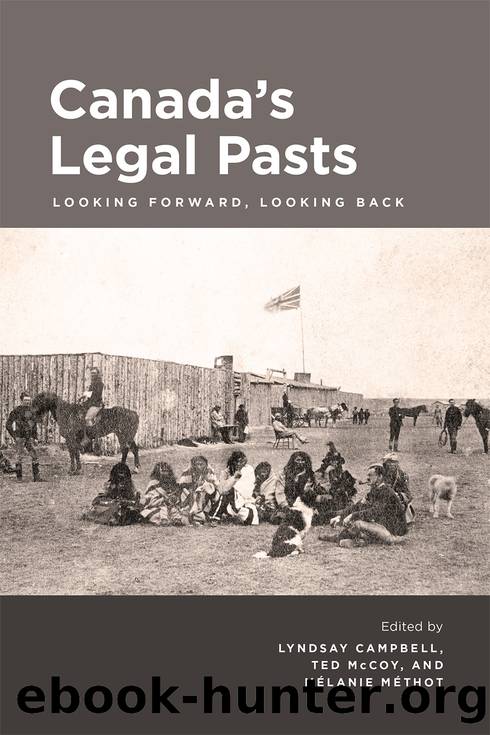
Author:Lyndsay Campbell
Language: eng
Format: epub
Tags: History; Law; Canada
ISBN: 9781773851198
Publisher: University of Calgary Press
Published: 2020-03-19T22:07:41+00:00
The Legal Framework of Criminal Justice in the North-West Territories
The acquisition of the territory of the western plains in 1870 had been a priority for the young Canadian state, one that eclipsed any process or consultation with the Indigenous peoples who lived there. However, the matter of the establishment of the institutions for the administration of justice also was not an immediate priority. The âinadequate legal system,â described by Peter Ward as a renovated âhand-me-down judicial systemâ from the Hudsonâs Bay Company, was one in which the Lieutenant-Governor of the NWT was empowered to appoint a recorder and justices of the peace.22 Six justices were appointed. Neither a legislative framework nor new institutions for the administration of justice were created until 1873, when John A. Macdonaldâs government âhastilyâ23 introduced a trio of federal statutes to provide for the creation of the Department of the Interior (whose minister was to have control and management of the affairs of the NWT and to act as Superintendent General of Indian Affairs), for the administration of justice and the creation of the NWMP, and for the application of Canadian criminal legislation to the Territories.24
The most important Act introduced the office of stipendiary magistrate as the senior judicial position in the NWT, and created the North-West Mounted Police,25 originally a force of three hundred men whose ranks rose and ebbed over the next three decades at the will of their political masters.26 Although the police force was established almost immediately, the stipendiary magistrates were not appointed until 1876, when James Farquharson Macleod, Matthew Ryan, and Hugh Richardson received their commissions.
By the NWMP Act, 1873, a stipendiary magistrate was to be appointed âby commissionâ by the Governor General, to receive a yearly salary of $3,000 (as well as actual travel expenses), to hold office within the NWT âduring pleasure,â with the ability to perform magisterial and judicial functions of a justice of the peace or two justices of the peace.27 The stipendiary magistrate was given summary jurisdiction to âhear and determine . . . without the intervention of a jury,â a wide range of offences, including larceny, assaults, sexual assaults on young girls, and obstruction and assault upon judicial and other officers in the execution of their duty, and to sentence convicted individuals to terms of imprisonment less than two years.28
The Manitoba Court of Queenâs Bench was to play a role in respect of offences Parliament considered more serious: either a judge of that Court or two stipendiary magistrates sitting together were empowered to conduct trials without a jury for offences punishable by up to seven years imprisonment.29 Only a Manitoba Queenâs Bench judge had jurisdiction to try, before a jury, anyone charged with a capital offence.30
The North-West Territories Act, 187531 consolidated and amended the administrative institutions and legal framework of the Territories. The Lieutenant-Governor and Council were empowered to establish ordinances (local legislation for the Territories), which were to be laid before Parliament but no longer required its prior approval.32
The 1875 Act limited the summary
Download
This site does not store any files on its server. We only index and link to content provided by other sites. Please contact the content providers to delete copyright contents if any and email us, we'll remove relevant links or contents immediately.
The Vikings: Conquering England, France, and Ireland by Wernick Robert(84384)
Ali Pasha, Lion of Ioannina by Eugenia Russell & Eugenia Russell(40321)
The Conquerors (The Winning of America Series Book 3) by Eckert Allan W(37986)
The Vikings: Discoverers of a New World by Wernick Robert(37007)
Cecilia; Or, Memoirs of an Heiress — Volume 1 by Fanny Burney(32639)
Cecilia; Or, Memoirs of an Heiress — Volume 2 by Fanny Burney(32013)
Cecilia; Or, Memoirs of an Heiress — Volume 3 by Fanny Burney(31997)
Empire of the Sikhs by Patwant Singh(23138)
The Secret History by Donna Tartt(19311)
Hans Sturm: A Soldier's Odyssey on the Eastern Front by Gordon Williamson(18652)
Cat's cradle by Kurt Vonnegut(15446)
Pimp by Iceberg Slim(14686)
Sapiens: A Brief History of Humankind by Yuval Noah Harari(14466)
Norse Mythology by Gaiman Neil(13459)
Talking to Strangers by Malcolm Gladwell(13445)
Leonardo da Vinci by Walter Isaacson(13413)
4 3 2 1: A Novel by Paul Auster(12520)
Underground: A Human History of the Worlds Beneath Our Feet by Will Hunt(12148)
The Radium Girls by Kate Moore(12096)
